Part 2: The Letter My Mother Left for My Sister
Paige stared at the envelope as though she were afraid to open it. Around us, more than a hundred wedding guests had fallen silent, but for the first time since she entered the chapel, my sister didn’t seem interested in their attention.
Her fingers trembled as she broke the seal.
“This is ridiculous,” she whispered.
But she opened the letter anyway.
Her eyes moved across the first line, and almost immediately, the confidence disappeared from her face. She pressed one hand over her mouth while the paper shook between the fingers of the other.
My sweet Paige, if you are reading this, it means you are hurting louder than you are loving.
My throat tightened as I watched her.
I had already read my own letter, but I had never opened Paige’s. Mom had made that condition very clear: whatever she had written belonged to my sister, and Paige alone had to decide whether anyone else would hear it.
For several seconds, she said nothing.
Ethan gently squeezed my hand.
“You don’t have to continue this,” he whispered.
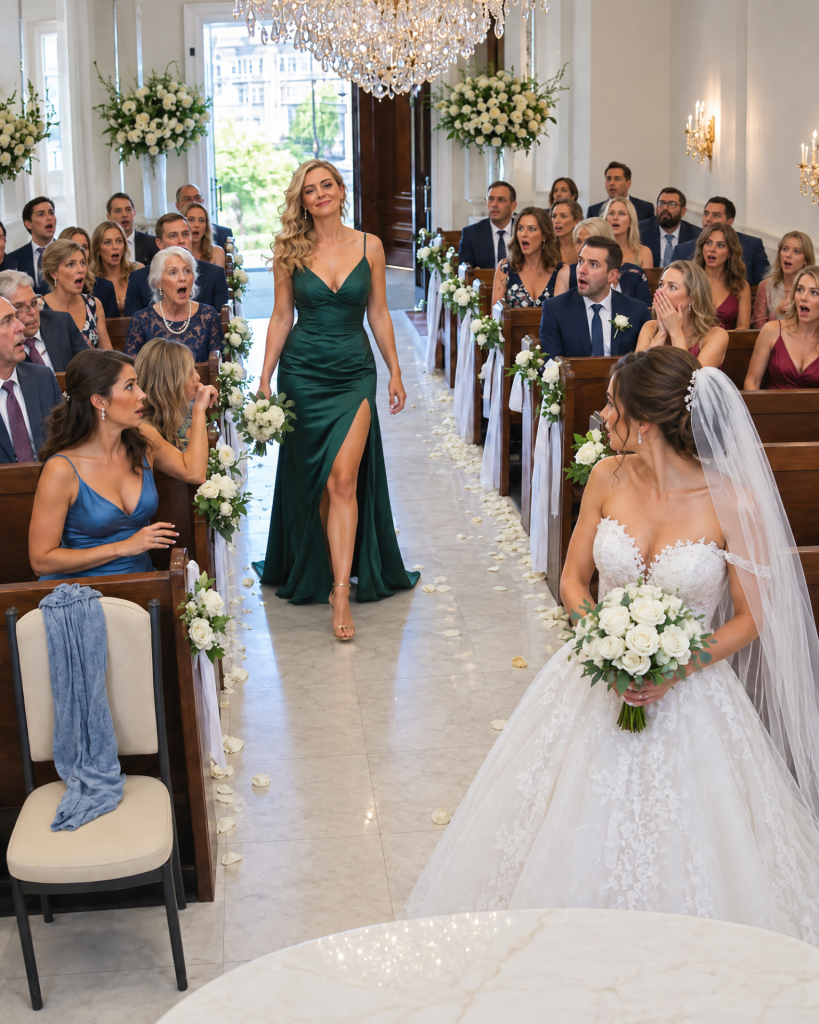
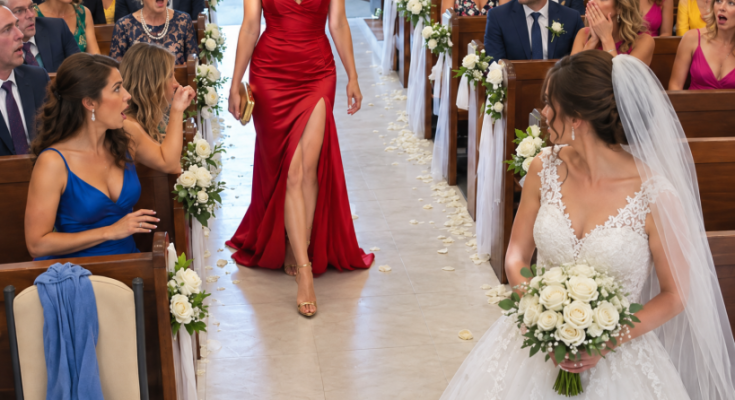
I looked toward Mom’s empty chair, where the blue scarf remained folded across the seat. Then I looked back at Paige, standing in the white dress she had chosen to wear as a challenge.
“Yes,” I whispered. “I do.”
Paige swallowed and looked at the letter again. When she finally began reading aloud, her voice was so quiet that the people in the back rows leaned forward to hear her.
“Mom says she knew the face I made whenever I felt forgotten. She knew I used jokes when I was hurting, and that I learned to say something cruel before anyone could ask what was wrong.”
Paige stopped and looked at me.
There was something in her expression I hadn’t seen in years.
Fear.
Not fear that the guests would judge her for wearing white, but fear that our mother had understood exactly why she had done it.
My father shifted in the front row. For most of our childhood, he had described Paige as “fire” and me as “water,” as though those labels explained everything about us.
Paige was loud, emotional, impulsive, and impossible to ignore. I learned early that being the quieter daughter made life easier for everyone, so whenever Paige exploded, I was expected to remain calm.
When she made mistakes, I was asked to understand. When she demanded attention, relatives reminded me that I already received plenty.
At the time, I thought those compromises kept our family peaceful.
Standing at the altar, I began wondering whether they had helped create the problem instead.
Paige continued reading.
“Mom says we were never supposed to become enemies. She said somewhere along the way, we started competing for love that already belonged to both of us.”
My chest tightened.
For years, I had built a simple explanation for my sister: Paige was jealous, selfish, and incapable of allowing anyone else to be happy without making the moment about herself.
That explanation wasn’t entirely wrong.
But maybe it wasn’t complete.
Paige wiped her cheek and continued.
“She says if I’m wearing white at your wedding, everyone will assume I wanted to steal your day.”
A nervous breath moved through the chapel.
Paige’s voice became quieter.
“She says maybe part of me did.”
Nobody moved.
Then she read the next sentence.
“But she thinks another part of me wanted someone to stop me. Someone to notice how lost I’d become.”
Paige broke.
The letter slipped from her fingers and fell onto the chapel floor as she covered her face. There was nothing graceful or theatrical about the way she cried; it sounded like years of anger had finally collapsed under their own weight.
For a moment, I remained beside Ethan.
I had imagined confronting Paige countless times. In some versions, I finally told her everything she had done to me; in others, she stormed out while everyone watched her humiliation.
I had never imagined feeling sorry for her.
Slowly, I stepped down from the altar.
That was when Paige finally looked at what I was wearing.
My wedding dress wasn’t white.
It was pale blue.
Mom’s favorite color.
It matched the scarf resting on her empty chair and reminded me of the dresses she wore in the photographs where she looked happiest. Paige had expected to stand beside me in white and force everyone to compare us, but there was no comparison to make.
“Don’t,” Paige whispered as I approached.
I stopped in front of her and picked up the letter.
“I didn’t know,” she said.
“Didn’t know what?”
“That Mom saw me like that.”
I handed the letter back.
“She saw both of us.”
Paige shook her head.
“No. She saw you. She always saw you.”
There it was.
The sentence beneath almost every argument we had ever had.
Paige looked directly at me, no longer caring about the guests surrounding us.
“You were the daughter she was proud of. Clara got good grades. Clara remembered everyone’s birthday. Clara helped when Mom was sick. Clara never caused trouble.”
Her voice cracked, but she continued.
“And I was always the difficult one. Too loud. Too emotional. Too much.”
I could have answered with a list of everything she had done to me. I could have reminded her of the milestones she had disrupted, the cruel jokes she had disguised as humor, or the days she disappeared while Mom was dying.
Instead, I told her the truth she had never considered.
“I needed things too, Paige.”
She blinked.
“I just learned to stop asking.”
For the first time that day, my sister had no answer.
Then she looked down at the letter again, and her expression changed.
“There’s more.”
I already knew that.
What I didn’t know was what Mom had written next.
Paige slowly unfolded the second page, read the first few lines silently, and then looked at me with tears running down her face.
“Clara,” she whispered, “Mom said our family has been doing this for generations.”
She turned the page toward me.
At the top, underlined twice in our mother’s handwriting, were two words I had never heard her use while she was alive.
Family curse.