Chapter 5
“That is a complete lie!” Patricia shrieked, though the defensive wobble in her voice revealed her desperate terror. “David, tell her! Tell her that your investment company owns the foundational capital of this entire family enterprise!”
My father remained frozen in seat 2A, staring at the tray table in front of him without making a single move. He looked older now, the artificial bronze of his skin fading into a pale, sickly gray under the cabin fluorescents.
“David!” Patricia snapped, shaking his shoulder with visible agitation. “Say something! We have an emergency court hearing scheduled in two hours! Tell this girl that she has no legal right to freeze our family accounts!”
My father slowly turned his head to look at me, his eyes hollowed out by the sudden realization of his total ruin. “Nora… please. We don’t have to destroy thirty years of family standing over business disagreements. We can negotiate an equitable settlement.”
“There is nothing to negotiate, Dad,” I said quietly, looking down at the man who had let me carry their bags. “You made your choice at Terminal 4 when you looked away. You chose Patricia’s cruelty over your daughter’s dignity.”
The seatbelt sign chimed overhead as the aircraft began its smooth descent toward the snow-capped peaks of Colorado below. Outside the double-paned windows, the sharp, jagged crests of the Rocky Mountains rose like ancient sentinels through the thinning cloud cover.
I returned to my seat in the private annex as Cheryl brought me a secure satellite phone with an open patch to Manhattan. The clerk of the probate surrogate court was reading out the official docket number for the emergency petition filed by my father.
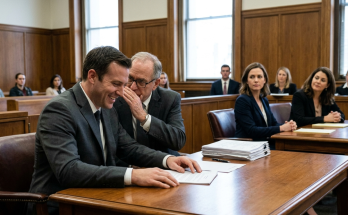
“Court is now in session via teleconference,” the judge’s crisp, no-nonsense voice resonated through the encrypted receiver. “We have petitioner David Bennett represented by counsel, and respondent Nora Bennett appearing remotely from flight transit. Counsel, state your emergency motion.”
My father’s high-priced attorney spoke first, his tone dripping with practiced urgency and dramatic theatrical indignation. He claimed that I had illegally hijacked the controlling shares of Bennett Aero Holdings, depriving the rightful family beneficiaries of their life-sustaining income.
He argued that Patricia Bennett and Mason Bennett had relied upon these trust disbursements for their foundational family security for years. He demanded an immediate judicial restraining order, freezing the aviation company’s governance until a full trial could be conducted in New York.
When he finally finished his breathless presentation, the surrogate judge cleared her throat with audible impatience across the line. “The court has reviewed the initial emergency filing. We will now hear from counsel for respondent Nora Bennett. Mr. Vance, proceed.”
Arthur Vance’s calm, gravelly voice entered the record like a heavy steel hammer falling upon an anvil. “Your Honor, the petitioner’s motion is built upon an intentional, fraudulent concealment of the nineteen ninety-eight post-nuptial corporate separation agreement.”
Arthur uploaded three encrypted documents directly into the digital court repository with a few swift keystrokes. “These notarized filings demonstrate that petitioner David Bennett surrendered all rights to Bennett Aero assets in exchange for debt relief thirty years ago.”
“Furthermore,” Arthur continued, his voice steady and clinical, “the trust specifically stipulates that controlling authority automatically reverts to Nora Bennett upon her thirtieth birthday. That milestone occurred three months ago, and today’s board vote was merely a formal procedural verification.”
The judge paused, the sound of digital pages turning echoing through the private cabin’s satellite audio speaker. “Counsel for petitioner, did you fail to disclose the existence of this nineteen ninety-eight post-nuptial separation agreement to this court?”
My father’s attorney stammered, his voice losing every shred of its previous theatrical confidence over the open connection. “Your Honor… my clients were operating under the good-faith belief that subsequent trust amendments had superseded those earlier historical filings.”
“Belief is not law, counselor,” the judge snapped coldly, her irritation cutting through the static like a sharp scalpel. “This court does not entertain fabricated emergency petitions designed to disrupt verified corporate governance while parties are traveling across state lines.”
Patricia’s muffled voice suddenly broke into the background of my father’s attorney’s audio, screeching with shrill, uncontained panic. “Tell her about the chalet! Tell her that Mason’s engagement dinner is tonight and we cannot access the payment reserves!”
“Who is that speaking in the background?” the judge demanded sharply. “Counsel, advise your clients that contempt citations will be issued immediately if decorum is breached during this telephonic judicial hearing! This is an official court of law!”
My father’s attorney hastily apologized, his voice trembling as he muted the distant background sounds of Patricia’s hysteria. The damage, however, was already completely done; the judge’s patience with their desperate maneuver had entirely evaporated into thin air.
“The petition for an emergency restraining order is denied with prejudice,” the judge ruled without an ounce of hesitation. “Furthermore, this court orders a comprehensive forensic audit of all trust disbursements made to the petitioner over the last five years.”