Chapter 2
Maya looked toward the street. For the first time, her confident expression disappeared completely. “Somewhere,” she answered. It wasn’t really an answer, and we all knew it. Sophie quietly reached into her backpack and pulled out the unopened lunch she had brought from home.
“You can have mine,” she said.
Maya immediately shook her head. “No, sweetheart. You need to eat.” Sophie pushed the lunch toward her anyway. “I already had a snack.” I watched Maya hesitate before accepting it with both hands, almost as though someone had taught her that accepting kindness came with a price.
I turned to my driver and told him to bring the car around. Maya looked alarmed. “Please don’t call anyone.” I assured her that I wasn’t calling the police or anyone else. “We’re just going somewhere warm,” I said. “You can decide what happens after that.”
Sophie sat beside Maya in the back seat. For several minutes, neither of them spoke. Then Sophie suddenly asked, “How did you get so good at math?” Maya looked out the window and smiled faintly. “My father taught me,” she said. “He used to say numbers were honest because they never changed their answer just because you didn’t like it.”
I noticed the way Maya’s voice changed when she mentioned him. “Where is your father now?” I asked carefully. She lowered her eyes. “He’s gone.” Sophie reached for Maya’s hand without saying anything. Maya squeezed it once, and I realized there was far more to her story than being a homeless teenager.
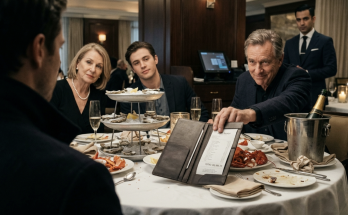
At the restaurant, Maya refused to sit until Sophie sat first. She kept looking around nervously, expecting someone to tell her she didn’t belong. I finally understood that this wasn’t about food. This girl had learned to make herself invisible because being noticed had probably caused her trouble before.
During dinner, Sophie laughed again. She told Maya about a science project she had failed twice and how her tutor had called it “a learning opportunity.” Maya laughed so hard she nearly dropped her fork. I sat across from them, watching my daughter become someone I hadn’t seen in years.
Then Maya suddenly became serious. She reached into her backpack and pulled out an old, folded sheet of paper. “I wasn’t going to show anyone this,” she said. She placed it on the table between us.
I unfolded it and felt my stomach tighten.
It was covered with mathematical equations, diagrams, and handwritten notes.
But at the bottom of the page was a name I recognized.
My wife’s name.
I looked at Maya in disbelief.
And before I could ask a single question, she whispered, “Your wife knew my father.”
I could not breathe as my eyes scanned the handwriting across the yellowed page. The elegant curves of the letters belonged unquestionably to Claire, the woman whose absence had hollowed out my entire existence.
Maya sat stiffly across the booth, her slender fingers tightly locked together around her warm water cup. She watched my trembling hands carefully, waiting for an explosion or a dismissive laugh that never came.
“Her name was Dr. Claire Harrison,” I whispered, the words catching painfully in my dry throat. “She spent six years running an advanced educational research laboratory at the university before she fell ill.”
“My father was Professor David Vance,” Maya said, her voice dropping to a fragile hush. “He worked in the adjacent department of theoretical mathematics before the faculty stripped his tenure and took his work.”
Sophie looked back and forth between us, sensing the heavy weight of an adult sorrow that she could not fully comprehend. She gently placed her small palm over Maya’s bruised, chalk-stained knuckles.
“Claire mentioned a David Vance only once,” I recalled, staring into the middle distance of my memory. “She told me she had met a genuine visionary who cared more about children than grant money.”
“He cared about patterns that could heal minds,” Maya explained softly, leaning slightly forward over the table. “He designed algorithms to teach complex cognitive reasoning to kids with severe emotional trauma and learning hurdles.”
“Why did he lose everything?” I asked, looking directly into Maya’s sharp, intelligent brown eyes. “Claire told me his work was groundbreaking, but suddenly all public references to his research vanished completely.”
“Because a venture board offered him millions to turn the project into an exclusive defense surveillance software,” Maya answered, her jaw hardening. “He refused, and within a single semester, his laboratory was locked.”
“Claire was on that oversight board,” I murmured as an icy chill traveled down my spine. “She resigned abruptly eighteen months before she was diagnosed with cancer, but she never explained the real reason.”
Maya pulled a second folded document from the battered lining of her taped backpack. “She didn’t quit in defeat, Mr. Harrison. She took half of the core mathematical architecture to keep it safe.”
READ ENDING HERE ⤵️👇