
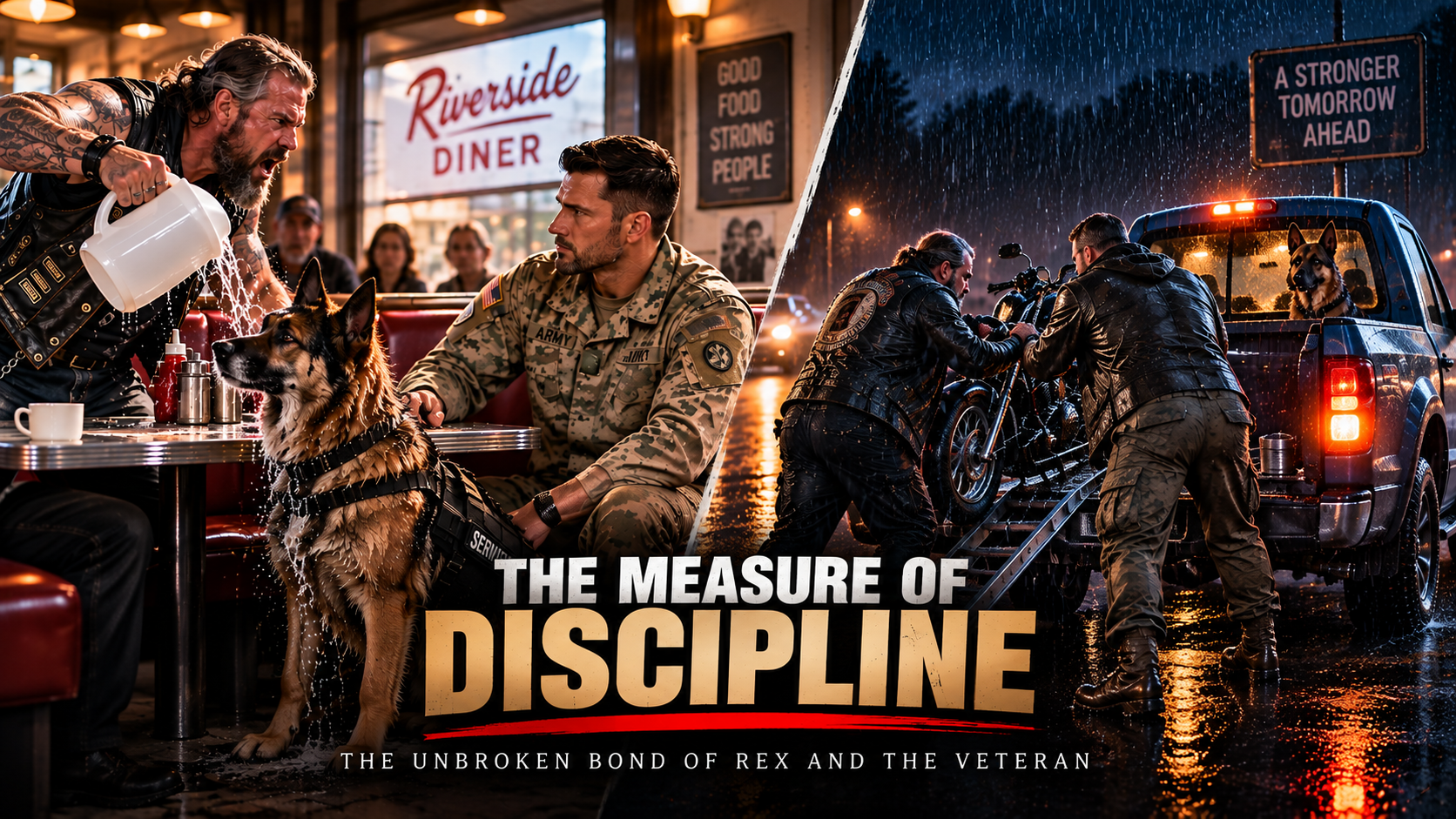
In high-stakes confrontations, real strength rarely shouts. It sits quietly with disciplined focus, grounded in patience and mutual respect. The journey of a quiet military veteran and his Belgian Malinois and German Shepherd mix, Rex, demonstrates how de-escalation, accountability, and mercy can turn a hostile encounter into an enduring bond. Spanning four interconnected moments—from an unprovoked diner provocation to a rainy night rescue on an empty rural highway—this story chronicles the transformative power of self-command.
Ch1: Do Not Disrespect Rex
In a crowded roadside diner, real strength rarely shouts. It sits quietly in a worn red vinyl booth, eyes forward, pulse steady, comfortable in its own discipline.
The confrontation began on a clear afternoon when an imposing shadow fell across the pale laminate table. Butch, a broad, heavyset biker wrapped in a black leather vest and dark tattoos, was looking for friction. To Butch, the quiet veteran sitting across the aisle in camouflage fatigues looked like an easy target, and the dog resting on the speckled floor was an excuse to provoke a scene. Without warning, Butch picked up a heavy white plastic pitcher from the counter, leaned across the aisle, and dumped a broad sheet of cold water directly over the head and shoulders of Rex, an adult Belgian Malinois and German Shepherd mix.
The diner went dead silent. Water cascaded through Rex’s thick coat, soaked his olive working harness, and pooled across the linoleum floor. Every customer braced for immediate violence.
Yet Rex did not lunge, growl, or snap. He flinched slightly from the sudden chill, raised his amber eyes toward his handler, and held his ground with rigid, unyielding patience. His reaction was not born of submission, but of rigorous training and absolute trust in the man beside him.
The veteran’s jaw tightened, but his breathing remained measured. Butch reclined in his booth, laughing loudly to mask the unease creeping into his chest. “Not so tough now, is he?” Butch sneered.
The veteran did not shout or display theatrical rage. He rose steadily from the bench in one smooth, balanced motion and stepped into the aisle. Butch stopped reclining and stood up opposite him. With deliberate precision, the veteran operated the silver clasp on Rex’s collar, separating the leash and giving a quiet, firm command: “Place.” Rex stepped clear of the central aisle, sat squarely against the booth window, and watched.
Stepping into Butch’s space, the veteran met the biker’s mocking stare with cold resolve. When Butch asked what army he brought to back him up, the veteran answered in a low, level voice: “I don’t need one.” As background bikers rose from their seats, the veteran glanced down at his partner: “Stay. I’ve got this.” True discipline had drawn the line without throwing a single punch.
Ch2: You Didn’t Ask
Ego escalates conflicts; genuine accountability resolves them. Seconds after the confrontation crystallized, the diner aisle hung on a razor’s edge. The bikers stood behind Butch, their posture defensive but uncertain, while Rex maintained his sit beside the window.
Breaking the stalemate was Gray, an older biker in his sixties whose weathered face, long gray beard, and calm demeanor carried unmistakable natural authority. Gray stepped forward and placed a steady hand on Butch’s shoulder. “That’s enough, Butch,” Gray commanded in a low, gravelly voice. Pointing toward Rex, he added: “That harness means he served. Show some respect.”
The words hit Butch harder than an open strike. His swagger collapsed into visible shame, and his gaze fell to the floor. “I didn’t know,” he muttered.
The veteran looked directly at him, offering no satisfaction or mockery. “You didn’t ask,” he replied plainly.
Redemption did not begin with speeches; it began with humble physical labor. Butch retrieved the same white plastic pitcher, carried it to the counter, and had the waitress fill it with clean water. He poured it into a stainless steel bowl, walked back, and lowered himself into a respectful crouch at a measured distance from Rex. He set the bowl down with both hands and withdrew without attempting to touch or pet the dog.
Rex looked at the bowl, checked with his handler, and drank only when the veteran gave a gentle release: “Okay.” While Rex drank, Butch knelt on the floorboards with a clean rag and quietly scrubbed the spilled water until the tiles were dry. Gray gave one approving nod, and Rex’s tail swept the floor once. An authentic apology requires work, not performances.
Ch3: The Reason
Discipline in a working dog is often misunderstood by onlookers as robotic coldness, until crisis exposes its true necessity.
Minutes later, out in the gravel parking lot, a young mother exited the diner holding a paper takeout bag while her two-year-old son, Tommy, bounced a red rubber ball. At ankle height, the ball slipped from Tommy’s hands, bounced twice on the gravel, and began rolling toward an open two-lane highway where distant traffic hummed. Tommy broke away and bolted directly after it.
The mother’s panic was immediate: “Tommy!”
Rex’s ears shot forward and his muscles tensed, but he held his sit and looked instantly to the veteran for permission. The handler gave a sharp, controlled flat-hand signal: “Rex. Block.”
Rex accelerated across the gravel in smooth, powerful strides. He did not pursue the child like prey; he calculated the vector, overtook the boy, and planted his broad body firmly between Tommy and the roadway. When the toddler stopped, Rex took one slow, deliberate step forward, using his chest to gently shepherd the child backward without jumping or barking until the breathless mother scooped her son into her arms. Rex then retrieved the rolling ball in his jaws and placed it neatly at the boy’s sneakers.
Watching from behind the diner window, Butch observed the rescue in stunned silence. “Now I get it,” he admitted quietly to himself. The composure he had mocked inside was the exact shield keeping an innocent life safe outside.
Ch4: The Storm
Three weeks later, circumstances reversed entirely on a rain-soaked rural highway at night. Water returned—not as an instrument of humiliation, but as the setting for mercy.
A heavy autumn downpour swept over the mountain pass in visible sheets. Butch found himself stranded beside his dead cruiser on the muddy shoulder, drenched to the bone, shivering, and repeatedly failing to turn the ignition. He lowered his head in physical exhaustion and defeat.
Headlights sliced through the rain as a faded blue single-cab pickup truck pulled onto the shoulder with amber hazard lights blinking. Inside the cab, Rex noticed Butch first, giving a quiet alert huff that drew the veteran’s attention.
The veteran stepped out into the storm with his hood raised and flashlight lowered: “Need a hand?”
Shame washed over Butch in waves. Rain streaming through his beard, he asked: “After what I did? Why?”
The veteran offered no lecture or moralizing sermon. He simply tossed his truck keys in a clean arc: “Pop the tailgate.”
Straining together, their boots slipping naturally on the wet asphalt, the two men rolled the heavy motorcycle up an aluminum ramp and strapped it securely into the truck bed while Rex watched calmly through the rain-streaked rear window.
When both men climbed into the warm cab, heavy rain drummed against the roof. Butch sat pressed against the passenger door, soaked and silent, with Rex sitting between them on the bench seat. Breaking the tension, Rex slowly leaned across and rested his warm chin directly on Butch’s wet shoulder. Butch placed a careful, tattooed hand on Rex’s back.
“About the diner—” Butch began quietly.
Keeping his eyes fixed on the dark road ahead, the veteran shifted into gear and replied: “He forgave you first.” Rex’s tail struck the bench seat once as the blue pickup carried all three of them into the night, completing a journey from hostility to mutual respect.
