Part 2: The Messages on My Sister’s Phone
Patricia finally stopped talking.
For as long as I could remember, my mother had always found a way to explain herself. Whatever happened, she could reshape it until she sounded reasonable and everyone else seemed responsible.
But now a police officer was holding Courtney’s phone.
And the message on the screen had come from Patricia herself.
If she asks for Ethan again, don’t give her the phone.
One officer asked Courtney to step into the hallway while the other remained beside Hannah’s bed. Separating them seemed to frighten my mother and sister more than any accusation could have.
Hannah looked toward the doctor.
“Courtney took my phone when I tried to call Ethan.”
The officer asked where it was.
Patricia immediately interrupted.
“She doesn’t know what she’s saying. She’s feverish.”
Nobody responded to her.
Instead, the officer asked Courtney to unlock her phone.
My sister hesitated.
“Why?”
“You’ll have an opportunity to explain everything,” he replied.
Courtney looked toward our mother before entering her passcode.
That glance told me something I hadn’t fully understood until then.
They had been coordinating.
They had discussed Hannah without her knowledge, decided how to handle her, and apparently agreed on what they would say if anyone questioned the bruises.
But they had left those conversations on their phones.
The officer began scrolling.
Within seconds, his expression changed.
There were dozens of messages between Patricia and Courtney from the previous three days.
She’s asking for Ethan again.
Don’t give her the phone.
She needs to stop pretending she’s sick.
Then another:
She hasn’t eaten.
Patricia’s response was short.
She’ll be fine.
My stomach tightened.
The officer continued.
Then he stopped at another message.
Keep the baby away from her until she calms down.
I looked at Hannah.
She was lying beneath a hospital blanket with an IV in her arm, barely able to keep her eyes open.
She had just given birth.
She had been feverish, dehydrated, and physically exhausted, yet while she begged to contact me, my mother and sister had discussed her as though she were a problem they needed to control.
Then the officer found a photograph.
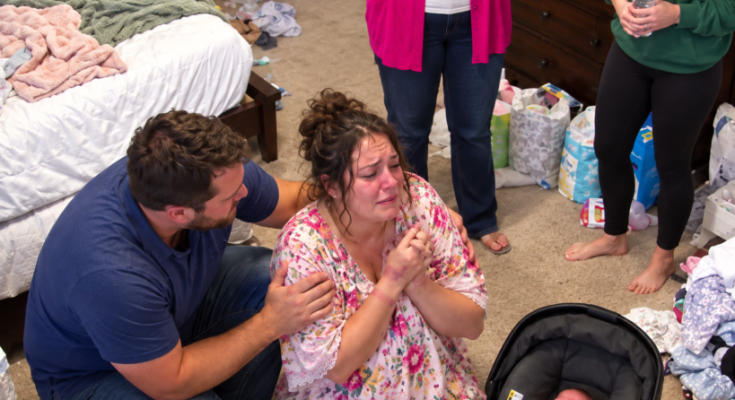
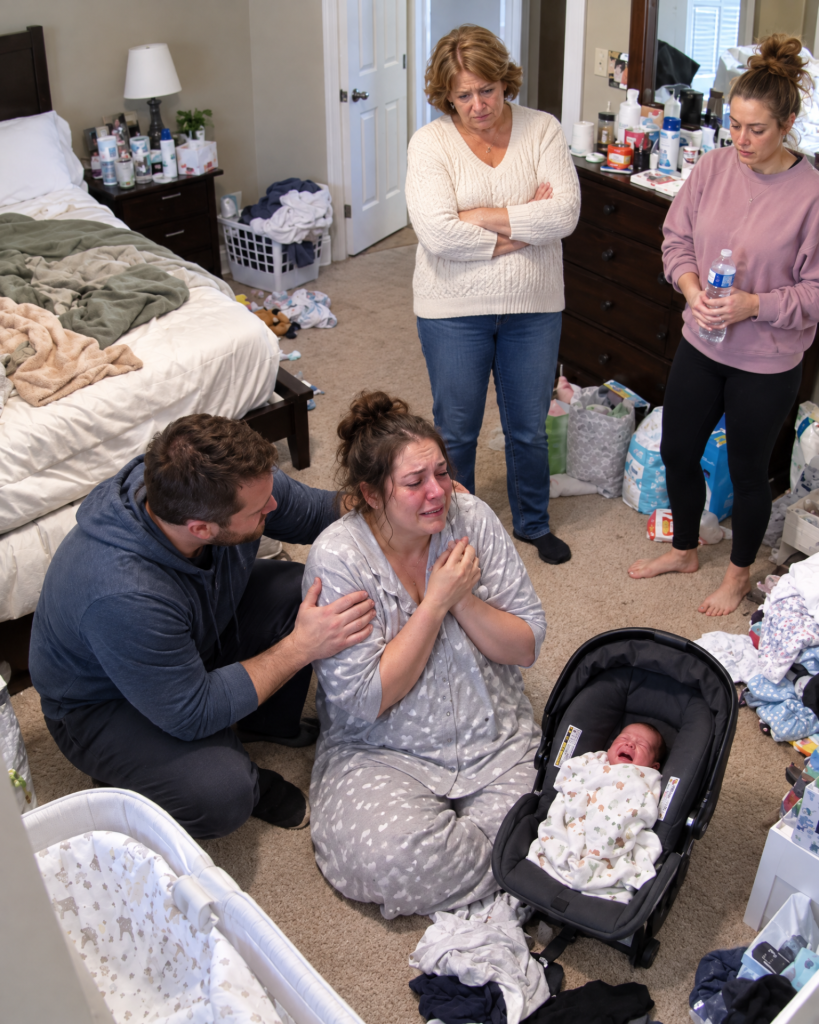
It had been taken inside our bedroom.
Hannah was lying on the floor.
The bruises were already visible around her wrists.
Courtney had sent the picture to Patricia.
Beneath it was a message.
She won’t stop trying to get up.
I stared at my sister.
“You took a photograph?”
Courtney began crying.
“I was scared.”
“You were scared?”
My voice was quieter than I expected.
“You photographed my wife lying on the floor instead of calling an ambulance.”
“I didn’t know what to do.”
“You did.”
I looked toward Hannah.
“You could have helped her.”
Courtney lowered her head.
The doctor returned a few minutes later and checked Hannah’s vitals.
“Her fever is responding to treatment,” she told us, “but she’s severely dehydrated and needs continued monitoring. Interrupting her prescribed medication may have made her condition significantly worse.”
I closed my eyes.
For the first time, I understood how serious this could have become if I had returned home even later.
Then I heard a small cry.
Owen.
A nurse brought him into the room.
His face was flushed, his tiny fists clenched tightly as he cried. I took him carefully into my arms and held him against my chest.
“I’m here, buddy.”
His crying gradually softened.
I looked at my son.
Then at Hannah.
And in that moment, I made a decision.
Patricia would never be alone with either of them again.
Not for an afternoon.
Not for five minutes.
Not because she apologized, cried, or reminded me that she was Owen’s grandmother.
About an hour later, a detective arrived.
He reviewed the photographs, the messages, Hannah’s statement, and the empty prescription bottles.
Then he asked Patricia to step into the hallway.
I couldn’t hear everything.
But I heard my mother’s voice rise.
“This is a family matter.”
The detective remained calm.
“When someone is prevented from calling for medical assistance, prescribed medication is withheld, and physical injuries are involved, it isn’t simply a family disagreement.”
Patricia went quiet.
Courtney was questioned separately.
Her explanation changed three times.
First, she claimed Hannah had injured herself.
Then she said Hannah had agreed to being restrained because she was “out of control.”
Finally, she admitted that they had held Hannah because she kept trying to leave the bedroom.
The detective wrote something down.
“Who told you to take her phone?”
Courtney didn’t answer.
She simply looked toward Patricia.
That seemed to be enough.
Later that evening, the detective returned to Hannah’s room.
“We have enough information to continue investigating,” he said.
“Are they going to be arrested?”
He paused before answering.
“Those decisions will depend on the evidence and the appropriate authorities. Right now, your priority should be keeping your wife and child safe.”
I looked at Hannah sleeping beneath the hospital blanket.
Then at Owen in my arms.
For once, I didn’t care about revenge.
I didn’t care whether Patricia admitted what she had done.
I needed my wife to recover.
I needed my son protected.
But just before the detective left, another officer returned with Courtney’s phone.
“There’s something else you should know.”
He had found messages from the night before I came home.
Messages showing that taking Hannah’s phone hadn’t been a decision made in the middle of an argument.
They had discussed doing it in advance.
And according to the officer, that wasn’t the most disturbing part.
READ ENDING HERE ⤵️👇