Part 5: The Family I Chose to Protect
“What kind of key?” I asked.
The detective paused.
“A small cabinet key.”
I immediately thought about Hannah’s medication, but there was no locked medicine cabinet in our bedroom. Then I remembered the wooden storage cabinet downstairs where we kept medical supplies, insurance paperwork, spare baby formula, and unopened packages of diapers.
Patricia knew about it.
When I returned home that afternoon, I checked the cabinet.
The lock showed signs of being used, but nothing obvious was missing. I photographed everything before touching it and sent the pictures to the detective.
Then Hannah noticed something.
“The formula.”
Several unopened containers had been moved from the back of the cabinet to a kitchen shelf.
Normally, that wouldn’t have meant anything.
But after everything else, neither of us was willing to dismiss unexplained changes inside our own home.
We documented what we found and let the investigator handle the rest.
For me, the more important truth was simpler.
My mother had repeatedly created ways to enter spaces she had never been invited into.
She had treated access as a right.
Our home.
Our bedroom.
Our newborn.
Even Hannah’s recovery.
Nothing had been allowed to belong entirely to us.
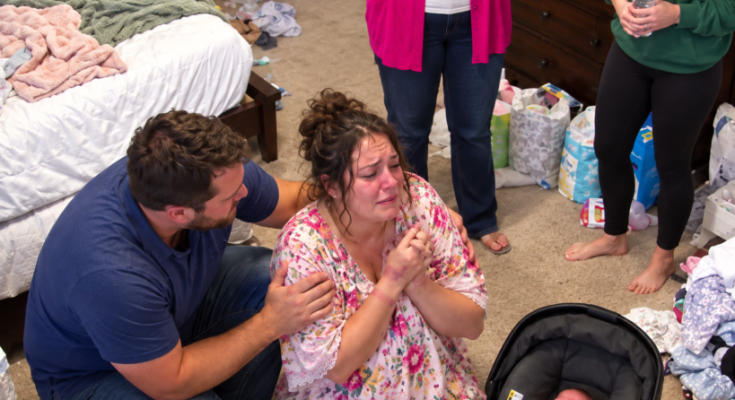
The investigation continued over the following weeks. The hospital records documented Hannah’s condition when she arrived: fever, dehydration, weakness, and bruising around both wrists.
The empty prescription bottles showed what had been taken from her.
Courtney’s phone preserved the messages my mother probably assumed nobody outside the family would ever read.
And the photographs proved something their changing explanations couldn’t erase.
They had known Hannah was getting worse.
They had watched it happen.
Two months later, we still didn’t know exactly what consequences Patricia and Courtney would ultimately face. The detective was careful not to promise outcomes before the process was complete.
Strangely, I was grateful for that.
I had spent the first few days wanting certainty.
I wanted someone to tell me exactly what punishment would happen and when.
Eventually, I realized that wasn’t what Hannah needed from me.
She needed stability.
She needed sleep.
She needed to hold Owen without wondering whether someone would suddenly walk through the front door and tell her she was doing motherhood wrong.
So that became my focus.
Patricia continued calling.
I stopped listening to the voicemails.
Courtney sent several messages, each slightly different from the last.
I was only following Mom’s instructions.
I didn’t understand how sick Hannah was.
I wish I had called you.
But the message Hannah never received was the simplest one.
I should have helped you.
Hannah chose not to answer.
I supported that choice.
One Sunday morning, I sat on our porch with Owen asleep against my chest. He had grown enough that his cheek no longer fit into the small space beneath my collarbone the way it had during his first week home.
Hannah came outside carrying two cups of coffee.
She sat beside me and smiled at him.
“He’s getting bigger.”
“Way too fast.”
For a while, neither of us said anything.
Sunlight stretched across the yard while Owen slept between us, one tiny hand curled against my shirt.
Then Hannah rested her head on my shoulder.
“He won’t remember any of this.”
I looked down at him.
“I hope he doesn’t.”
She was quiet.
“I wish I could forget it too.”
I turned toward her.
“You don’t have to forget.”
Hannah looked at me.
“You just need to know that what happened wasn’t because you failed.”
Her eyes filled with tears.
For months, Patricia had taught her the opposite.
If Hannah needed rest, she was lazy.
If she needed medication, she was weak.
If she wanted her husband, she was dramatic.
If she wanted her own baby, she was unstable.
Eventually, those accusations had become loud enough that Hannah started repeating them to herself.
Now we were learning to replace them with something else.
She had been recovering.
She had been sick.
She had asked for help.
And the people who should have helped her chose not to.
That truth belonged to them, not to her.
Owen stirred against my chest and wrapped his fingers around mine.
I smiled.
For the first time since the afternoon I walked into our house and found Hannah on the bedroom floor, I felt something stronger than anger.
Peace.
Growing up, my mother had taught me that family meant loyalty.
You kept problems private.
You protected relatives from embarrassment.
You forgave because blood was blood.
But I understood something different now.
Family isn’t the person who demands your silence so they can avoid consequences.
Family is the person who notices you’re struggling and gets help.
Family doesn’t take away your phone when you’re frightened.
Family makes sure someone answers when you call.
Hannah slipped her hand into mine.
Inside the house, the locks had been changed.
The emergency contacts were different.
Nobody had a key unless Hannah and I had personally given them one.
Those boundaries didn’t destroy our family.
They protected it.
I looked at my wife, then at our sleeping son.
Whatever happened with the investigation, Patricia, or Courtney, one thing would never change.
Hannah would never again have to beg someone for permission to call me.
Because from that day forward, whenever she needed me, I intended to answer.
The End.